
Cargo · June 2, 2026
Guide to Filling Out & Printing a Bill of Lading (BOL) for Shipping
What a Bill of Lading (BOL) is, why you need one, and how to fill out the form correctly.
In this article, we will discuss what a Bill of Lading (BOL) actually is, why you need one, and how to fill out the form correctly.
When filling out a Bill of Lading (BOL), please be careful — incorrectly filling in the data can become a serious problem and disrupt your shipping process.
The issues that may arise are quite varied, ranging from goods arriving late at their destination, being unable to file a warranty claim when goods are damaged in transit, to goods being shipped to the wrong address.
Everyone who has ever shipped goods understands that the Bill of Lading (BOL) is extremely important. However, many of them also lack a full understanding of — or even make mistakes when filling out — the Bill of Lading (BOL). Completing a BOL can sometimes be a little complicated and complex for several reasons:
- There are many different types of Bill of Lading (BOL)
- There are many fields and pieces of information that must be filled in
- Some people don't fully understand the importance of filling out a Bill of Lading (BOL) in detail
What Is a Bill of Lading (BOL)?
In Indonesian law, the Bill of Lading (BOL) is referred to as Konosemen, as defined in Article 506 of the Indonesian Commercial Code (Kitab Undang-Undang Hukum Dagang / KUHD):
"A konosemen is a dated document in which the carrier states that it has received certain goods with the intention of transporting them to a designated place and delivering them there to a designated person, along with the terms and conditions under which such delivery will be made."
Therefore, a Bill of Lading (BOL) can be defined as a legal document that you are required to complete before shipping goods. The BOL contains detailed information about the quantity, type, and destination of the goods being shipped, making data verification much easier.
A Bill of Lading (BOL) is typically issued by the carrier and given to the shipper. The purpose of the BOL is to protect all parties involved in the shipment — both the carrier and the shipper.
Learn more: Bill of Lading (BOL) in detail

Functions of a Bill of Lading (BOL)
Citing an article from BDC.CA, there are at least 3 key functions of a Bill of Lading (BOL):
- Proof of Contract The BOL serves as evidence — either physical (in the traditional form) or digital — that you have a contractual agreement to move goods with a logistics company.
The BOL obliges the carrier to hand over the cargo only to the entity listed as the recipient, or their authorized representative.
- Proof of Receipt The BOL is signed by the carrier once your goods are handed over to them.
That signature serves as confirmation that the goods were received in good condition. So, if you later find damage to the goods upon arrival at the destination, you can present the BOL as proof that the goods were originally in good condition.
If your goods are damaged during shipping, the signed BOL will show exactly what you actually shipped. In other words, the BOL can serve as strong evidence if you wish to file a damage claim with the shipping company.
- Proof of Ownership The BOL can function as legal proof of ownership of goods that are in transit. This is especially important in international trade transactions.
The BOL can also record the transfer of ownership of goods during the shipping process — so, for example, if the goods are sold while in transit, the new owner can update the BOL in their name.
From the functions described above, we can simplify the reasons why a BOL matters:
Why Is the Bill of Lading (BOL) Important?
- It provides transparency regarding the shipping status, allowing both the sender and recipient to track the location of the goods.
- It provides legal protection for all parties involved in the shipment.
- It is more efficient because all required information is contained in a single document, making coordination easier.
Learn more: Shipping Documents explained
Types of Bill of Lading (BOL)
1. Order Bill of Lading (BOL)
An Order BOL is often used in international transactions, especially when payment is not made upfront and the final recipient is not yet confirmed. It can be transferred or sold to a third party through endorsement (a signature on the back of the BOL).
2. Straight Bill of Lading (BOL)
A Straight BOL is often used for shipments that have been paid in full, or when the seller wants to retain control over the goods until they reach their final destination. Goods are delivered directly to the recipient named in the BOL and cannot be transferred to a third party.
3. Claused Bill of Lading (BOL)
A Claused BOL contains notes about damage, shortages, or conditions of the goods that do not match expectations when received by the carrier. This document can be used as the basis for filing an insurance claim in the event of damage or loss of goods during shipping.
4. Electronic Bill of Lading (e-BOL)
An Electronic Bill of Lading (e-BOL) is the digital version of a traditional BOL. It is widely used because it is highly efficient for recording the shipping process, and the data is relatively more secure since it is stored digitally compared to a paper-based traditional BOL.
5. Negotiable Bill of Lading (BOL)
A Negotiable BOL is often used in international trade transactions where ownership of the goods may change hands several times before reaching the final destination. It can be transferred to a third party through endorsement.
There are in fact many more types of Bill of Lading that cannot all be covered in this article.

Factors That Influence the Choice of BOL Type
- Payment terms: Is payment made upfront or after delivery?
- Condition of goods: Are the goods in good condition or is there damage?
- Shipping route: Does the shipment involve multiple modes of transportation?
- Insurance requirements: Are there specific requirements from the insurance company?
- Government regulations: Are there specific regulations in the destination country that need to be considered?
It is important to choose the right type of BOL to ensure a smooth shipping process and minimize the risk of loss.
Examples of Bill of Lading (BOL) Usage
- You are exporting furniture to the United States: You would use an Order Bill of Lading (BOL) because payment may be made after the goods arrive at the destination port, and you want to retain control over the goods until payment is received.
- You are importing raw materials that have been paid in full: You would use a Straight Bill of Lading (BOL) because the goods have already been paid for upfront, and you want to ensure that only the registered recipient can collect the goods.
- You receive a container shipment where some goods are damaged: You would request a Claused Bill of Lading (BOL) from the carrier to document the damage and file an insurance claim.
Image: ABC Express
Who Issues a Bill of Lading?
A Bill of Lading (BOL) is generally issued by the shipping company or transport company responsible for delivering the goods. The company will issue the BOL after receiving the goods from the shipper and being ready to transport them to the designated destination.
Why Is It Issued by the Shipping/Transport Company?
- Proof of Receipt: The BOL serves as proof that the carrier has received the goods from the shipper in a specific condition.
- Contract of Carriage: The BOL is also a contract between the shipper and the carrier, containing the terms and conditions of the shipment.
- Document of Title: The BOL can serve as temporary proof of ownership of goods that are in transit.
Who Else Can Issue a Bill of Lading (BOL)?
Although generally issued by shipping or transport companies, in some cases other parties appointed by the carrier may also issue a BOL — for example, a freight agent or logistics company acting as a representative of the shipping company.
Learn more: Difference Between Logistics and Warehousing
Key Information in a Bill of Lading (BOL)
- Name of sender and recipient: The identities of all parties involved in the shipment.
- Description of goods: Type, quantity, weight, and dimensions of the goods being shipped.
- Origin and destination: Where the goods are picked up and the final destination.
- Freight charges: The cost to be paid by the sender or recipient.
- Terms and conditions of shipment: Provisions applicable during the shipping process, such as the responsibilities of each party, delivery time, and claims procedures.
Contents of a Bill of Lading Document

Image: Freepik
A Bill of Lading is an important document containing complete information about a shipment. The mandatory information in a BOL includes:
- Identity of Sender and Recipient Full name of the company or individual, complete address, phone number, and other contact information.
- Description of Goods
- Type of goods (e.g., electronics, clothing, food products)
- Quantity of goods (in units such as boxes, pallets, or pieces)
- Weight of goods (in kilograms or tons)
- Dimensions of goods (length, width, height)
- Condition of goods upon receipt by the carrier (e.g., good condition, damaged)
- Origin and Destination
- Place of loading (port of loading)
- Place of discharge (port of discharge)
- Shipping route (if applicable)
- Mode of Transportation
- Type of transportation used (sea, air, land)
- Name of vessel or flight number (if applicable)
- Freight Charges
- Total shipping cost
- Currency used
- Payment terms
- Shipping Terms
- Incoterms (e.g., FOB, CIF) that determine the responsibilities of each party
- Date of BOL issuance
- Signature and stamp of the authorized party
6 Steps to Fill Out a Bill of Lading (BOL)

Step 1: Obtain a Blank Bill of Lading (BOL) Form
You can obtain a BOL form from the transport company you intend to use. They typically provide a standard format tailored to their own procedures, so you simply need to fill in the relevant information as required.
Make sure the BOL you are using carries the logo of the carrier or broker, to avoid billing issues and additional charges from using an incorrect document.
Also note that a BOL may differ slightly depending on the mode of transportation being used (sea, air, or land).
Step 2: Complete the Information on the Bill of Lading (BOL)
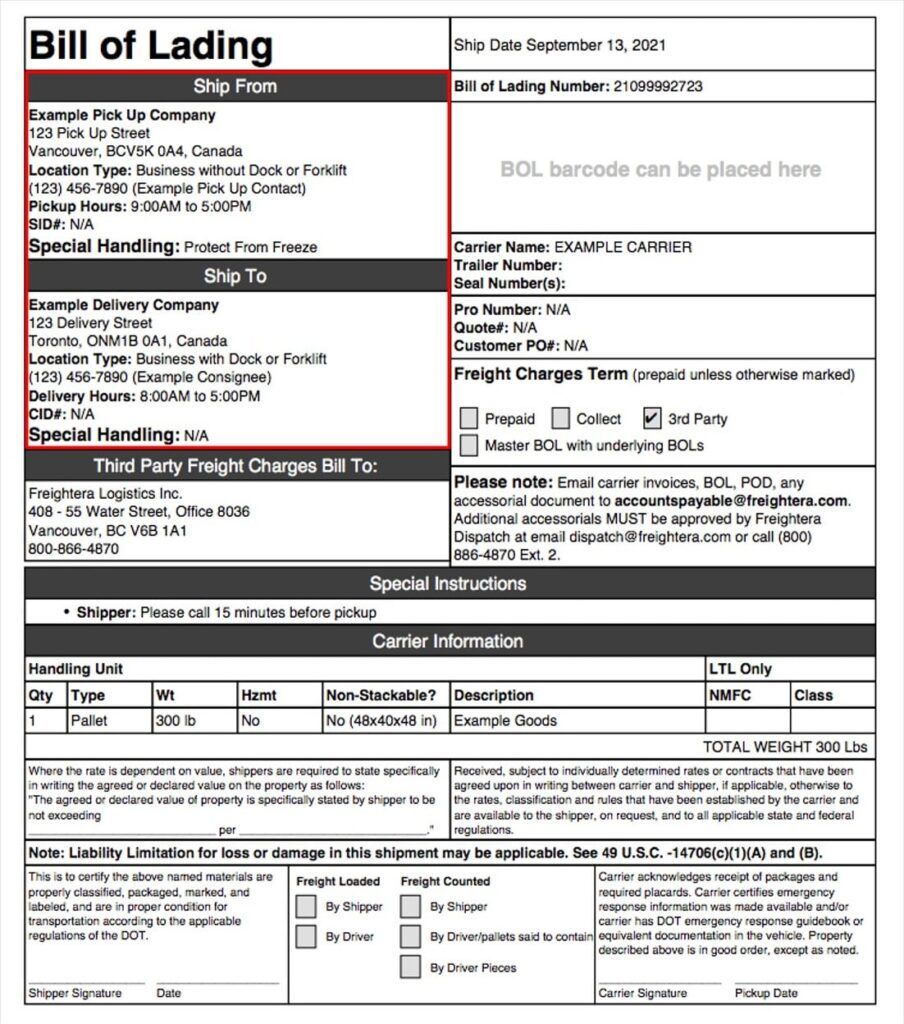
The information on a BOL is critically important, and this step must be done correctly.
- Full Name: Write the full name of the company or individual, for both the sender and recipient.
- Complete Address: Include the full address with postal code, country, and phone number.
- Contact Information: Include phone number, fax, and email address.
Transport companies may sometimes require additional information, such as:
- Is there a specific person who knows about the pickup or delivery of the shipment?
- Will the location be closed at any point?
- Are the operating hours correct?
This information is usually indicated on the company's BOL form.
Step 3: Enter Your Cargo Information
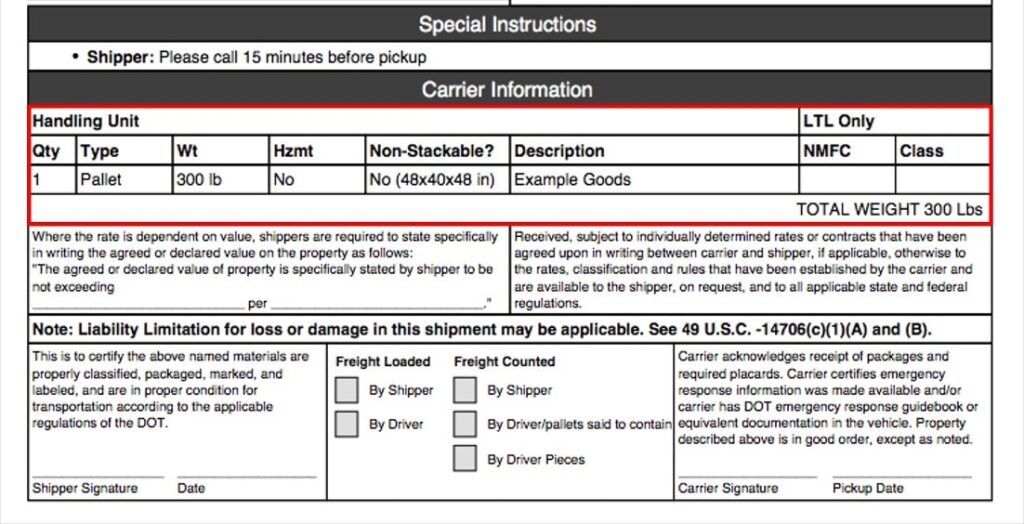
At this stage, you must specifically describe the cargo or type of goods you are shipping.
Make sure the information entered accurately reflects reality, and round up dimensions in centimeters to the nearest higher number.
If the information on the BOL does not match the actual shipment, additional charges may be applied.
- Quantity: Write the number of items in the appropriate unit (boxes, pallets, kilograms).
- Weight: Record the gross weight and net weight of the goods.
- Dimensions: Write the length, width, and height of each package.
- Condition: Describe the condition of the goods when handed over to the carrier (good, damaged, etc.).
- HS Code: If required for customs purposes, include the appropriate Harmonized System (HS) code for the type of goods.
For example, if you are shipping a Wooden Wardrobe, you can also include: number of pallets/boxes, cargo dimensions per pallet including the pallet itself, and weight per item (including packaging).
Example: Wooden wardrobe: 200 × 120 × 70 cm, 85 kg.
Step 4: Check for Additional Services
A single cargo shipment can contain different types of goods — such as books, glassware, or even chemicals. Each type of goods has specific handling requirements during shipping.
You can check the corresponding boxes on the BOL to inform the shipping company that your goods have special requirements.
For example:
- Do not stack: Your goods must not be stacked with other items because they could be damaged — for example, a large and heavy television.
- Fragile cargo: Your goods are easily broken or damaged — for example, a glass vase.
- Hazardous cargo: Your goods contain hazardous materials that must be handled with extreme care — for example, lithium batteries or chemical liquids.
This ensures that drivers and warehouse personnel give extra attention to your shipment when required.
Guide: Shipping Hazardous Goods
Step 5: Fill in the Special Instructions Box
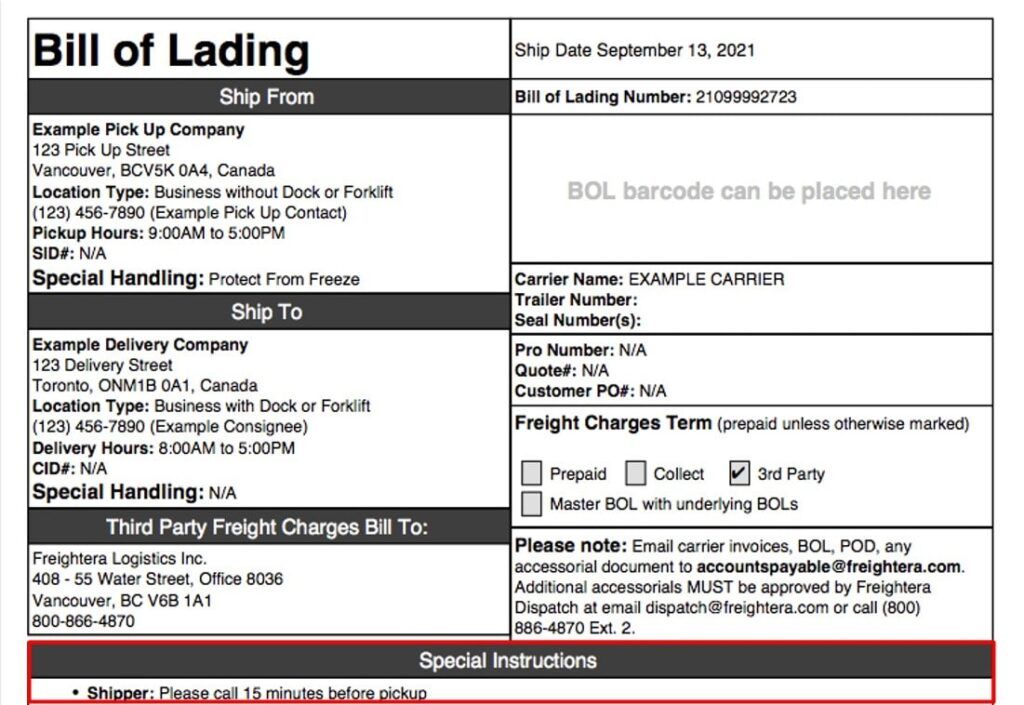
- Type of Transportation: Write the mode of transportation being used (sea, air, land, or a combination).
- Container/Vehicle Number: If already known, write the container or vehicle number to be used.
- Total Cost: Calculate the total shipping cost based on your agreement with the transport company.
- Currency: Write the currency used for payment.
- Payment Terms: Specify the payment terms (e.g., prepaid, collect at destination).
The BOL will contain a form where you can enter any additional information needed for the driver to handle your shipment correctly.
Step 6: Review All Information
Make sure to review everything. Even after entering all the required information, always double-check to ensure all data is correct.
Even a small error in the BOL — for example, writing 100 cartons when the actual number is 110 — can cause problems during shipping. For instance, the goods may not fit into the truck because there are more items than estimated.
Small mistakes in a BOL can lead to:
- Delayed delivery: Because goods must be returned or an additional vehicle must be arranged.
- Additional charges: You may have to pay extra fees due to your error.
- Goods damage: Goods may be damaged due to improper handling caused by incorrect information.
- Goods sent to the wrong address: Goods may be delivered to the wrong address if there is an error in the address or entity name.
This is why you must review all BOL data carefully and ensure you have entered the correct figures, dimensions, weights, and all other necessary details.
Image: ABC Express
Why Partnering with an Experienced Freight Forwarder Like ABC Express Is the Solution
- Expertise: ABC Express has extensive experience and knowledge in completing shipping documents, including the Bill of Lading (BOL).
- Accuracy: ABC Express ensures that all information in the BOL is accurate and complete.
- Procedures: ABC Express understands the procedures and requirements that apply across different countries and modes of transportation.
- Risk Minimization: With ABC Express's assistance, you can minimize the risk of errors that could have serious consequences.
"My experience working with ABC Express over the past 3 years has been quite good easy to coordinate, and if there are any issues, they take responsibility and come down to the field."
Eko Yusanto, Managing Director, PT Cahaya Emas Cemerlang (Industrial tools and machinery shipping, 3 years partnering with ABC Express)
Contact ABC Express here — our team is ready and willing to answer any questions you have and ship your goods.
Explore ABC Express Services in full here!